
AI Second Brain 🤖 Scrolls Into a Working Machine
An AI second brain 🤖 is not a warehouse of smart notes.
It is what happens when you take your scrolls — experience, recipes, methods, failures, processes, old chat threads, old decisions — and turn them into a working system that produces real artifacts 🎁
Not "hey neural net, make something up."
A proper pipeline 🛸
context → patterns → instructions → workflows → agents → automation → business impact
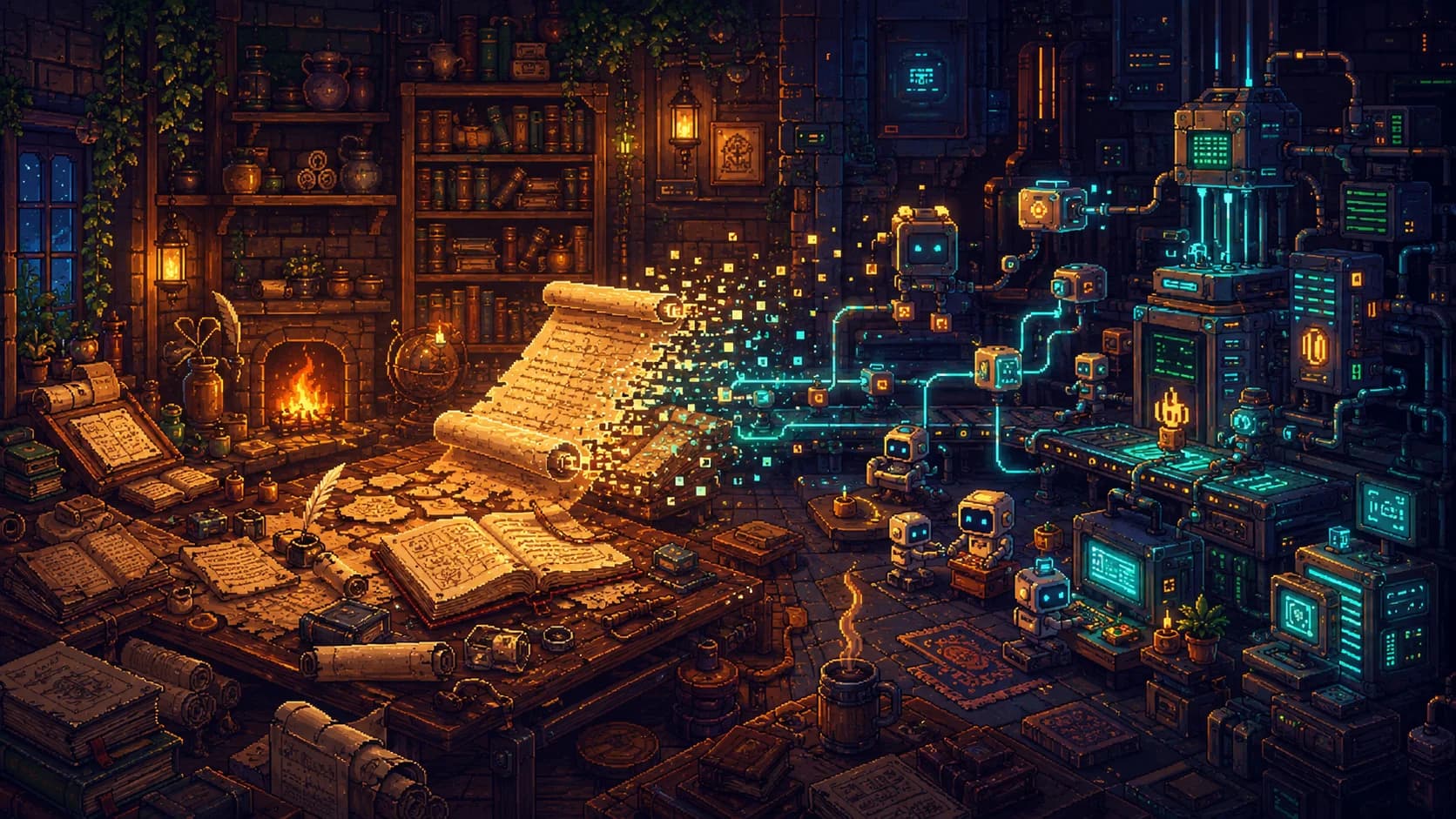
The scrolls assemble into a working mechanism.
From parchment to process
Watch what happens at each step.
A scroll with a recipe doesn't become a pretty paragraph — it becomes a clear process. A method becomes an instruction. An instruction becomes a workflow. A workflow becomes an agent, a bot, an automation.
The knowledge that used to live in your head and run "on experience" turns into an engineering system: with context, rules, steps and a measurable result.
That is the whole difference between a second brain and a note graveyard.
Notes store what you knew. A second brain runs what you know.
AI as a runtime for knowledge
Here is the frame I keep coming back to:
I don't like AI as a paragraph generator. I like AI as a runtime for knowledge.
A note is source code that never gets executed. Most "second brain" setups stop there — beautiful vaults, tags, backlinks, zero output. A runtime is different. You load your context into it — the real recipes, the real failures, the real constraints — and it starts producing:
- processes your team can actually follow
- instructions an agent can actually execute
- automations that actually close loops without you
Your experience stops just lying in notes and starts to evolve.
Every failure you documented becomes a guardrail. Every method you wrote down becomes a callable function. Every old decision becomes context the next agent inherits.
Instructions > vibes
The dividing line in AI work right now is exactly this.
Vibes: open a chat, improvise a prompt, get a plausible paragraph, retype it tomorrow because nothing was saved and nothing was learned.
Instructions: written context, explicit rules, defined steps — so the same task runs the same way on Monday and on the hundredth run, whether it's you, your teammate, or an agent executing it.
Vibes demo well. Instructions compound.
That's why the pipeline ends in business impact and not in "interesting output." Each stage is just knowledge getting one step closer to running on its own:
Context — collect the scrolls
Patterns — find what repeats
Instructions — write it down so it executes
Workflows — chain the steps
Agents — hand the workflow to something that runs 24/7
Automation — remove yourself from the loop
Impact — measure what actually changed
The scrolls have assembled into a working mechanism 🎁
We build these systems at Ravefox Lab — from oracle bots to full agent operations. If you want to see how one is wired inside, reach out 📎🪐